Choosing playground equipment involves a lot more than picking what looks good. Every decision – from the equipment you specify and the materials it’s made from, to how the space is laid out and who it’s designed for – has a direct bearing on how safe, inclusive and enjoyable the finished playground will be.
This guide covers the key considerations across each stage of playground planning – safety standards and legislation, design and inclusivity, materials, maintenance and the developmental benefits of outdoor play. Use the sections below as a reference point at any stage of your project.
• 1. Playground safety.
• 2. Planning and design.
• 3. Playground inclusivity.
• 4. Materials and environment.
• 5. Playground maintenance.
• 6. Child development.
Safety is the foundation of every playground project. Before any equipment is specified, procured or installed, it must meet the technical requirements set out in two core British and European standards: BS EN 1176, which governs the safety of playground equipment, and BS EN 1177, which sets requirements for impact-absorbing surfacing.
While neither is a legal requirement in itself, compliance with both is widely regarded as the minimum benchmark for responsible playground operation, and is a key consideration for insurers, inspectors and local authority procurement frameworks alike.
Playground operators have a legal duty of care under the Health and Safety at Work Act 1974 and the Occupiers’ Liability Acts 1957 and 1984. Meeting this duty in practice means conducting regular risk assessments, acting promptly on any identified hazards and maintaining accurate inspection records.
Learn more about playground safety and safety standards.
Good playground design must consider layout, theme, inclusivity and the flow of a play space – this influences how children move through a playground, how long they engage with a playground and how safe it is in practice. Equipment should be spaced to allow clear sightlines and safe circulation, with fall zones unobstructed and natural movement patterns built into the overall plan.
Planning a new playground also involves a number of practical considerations that sit alongside the design process. Depending on the location and scale of the project, planning permission may be required – particularly for fixed structures in public open spaces or on school grounds. Operators should also factor in realistic project timelines, including lead times for equipment manufacture and delivery, site preparation works and installation. For larger projects, phased budget staging is worth considering from the outset, allowing for future expansion or equipment additions without requiring a complete redesign.
Learn about how to plan and design a playground.
Inclusive playground design is also an important consideration when ensuring a playground is accessible to all in a community. An inclusive playground caters to children of varying ages, physical abilities and sensory needs – not as an afterthought, but as an integral part of the brief.
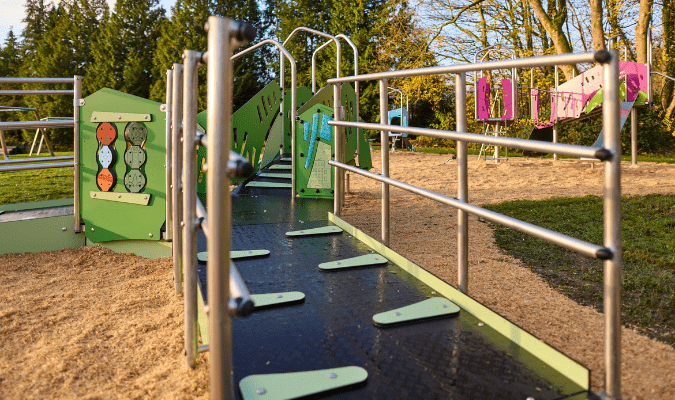
Examples of inclusive playground design include wheelchair inclusive roundabouts, equipment suitable for children with mobility impairments, and sensory-rich features that benefit neurodivergent children with sensory processing differences. This includes ensuring that access routes, transfer points and ground-level play are built into the layout, rather than bolted on later. This produces a far more cohesive and usable playground design that remains inclusive to all children.
There are also relevant standards and legislation that operators should be aware of. BS 8300 – the British standard for the design of an accessible and inclusive built environment – provides guidance on surface specifications, gradient requirements and the provision of accessible routes throughout outdoor spaces. Playgrounds serving the public are also subject to the Equality Act 2010, which places a duty on operators to make reasonable adjustments to ensure disabled people are not placed at a substantial disadvantage. Specifying accessible surfacing and ensuring unobstructed routes to and between play equipment are both practical steps towards meeting this obligation.
Learn about inclusive playground design.
The materials specified for playground equipment and surfacing have a significant bearing on safety, longevity and environmental impact. The most commonly used playground materials – including timber and steel – each carry different maintenance requirements, lifespans and environmental profiles.
Timber, for instance, offers a natural aesthetic and is renewable, but requires regular inspection for decay and treatment to maintain structural integrity – with Playdale timber guaranteed to last up to 20 years.
Steel is highly durable and resistant to impact, while HDPE is weather-resistant, low-maintenance and increasingly used for its sustainability credentials.
The choice of surfacing material is equally important. Wet-pour, bonded rubber mulch, loosefill wood fibre and synthetic grass all offer varying levels of impact attenuation, and must be selected and specified in accordance with BS EN 1177 to ensure they adequately protect against fall-related injuries.
The appropriate surfacing type for any given area depends on the equipment height, anticipated usage and the environment in which the playground sits.
Learn about how playground equipment materials support your design needs.
Even the highest-quality, fully compliant playground equipment will deteriorate without proper maintenance. Regular upkeep is a legal and operational responsibility.
Operators are required to conduct ongoing inspections at three levels: routine visual checks (weekly or as required), operational inspections (monthly or quarterly by a competent person) and annual main inspections conducted by a qualified, independent inspector – typically accredited by the Register of Play Inspectors International (RPII) or an equivalent body.
Common maintenance priorities include checking for timber decay at ground level, inspecting fixings and connections for corrosion or loosening, verifying that impact-absorbing surfacing remains intact and uncompacted, and confirming that fall zones remain clear and correctly dimensioned. Any defect that presents an immediate risk to users should result in the equipment being taken out of service until it is repaired to the required standard.
Learn more about playground equipment inspection and maintenance.
Outdoor play has a well-documented impact on children’s development across multiple areas. The physical demands of climbing, balancing, spinning, swinging and running build strength, coordination and gross motor skills, while the unpredictability of the outdoor environment encourages children to assess risk, problem-solve and build resilience in ways that structured indoor activities can’t replicate.
Playground design is incredibly beneficial to child social development. Shared equipment – including multi-user climbing frames to group swings and collaborative play panels – create natural opportunities for communication, turn-taking, negotiation and empathy. These interactions are particularly valuable for younger children developing early social skills, and for children with social or communication differences who benefit from structured opportunities for peer engagement in a fun, low-pressure environment.
Benefitting a child’s cognitive development, playground environments that incorporate varied textures, levels and interactive elements – such as musical instruments, sensory panels or nature-based features – support curiosity, concentration and imaginative thinking. Research consistently links regular access to quality outdoor play with improved attainment, better emotional regulation and stronger overall wellbeing.
For schools, nurseries and local authorities, these physical, cognitive and social benefits from well-designed play spaces help to improve child development outcomes.


We understand that every penny matters. Schools across the UK are under increasing pressure to make their budgets stretch further while delivering the best possible experience for pupils. With changes to PE and school sport funding on the horizon, planning and managing your budgets carefully is more important than ever. The UK Government has recently […]
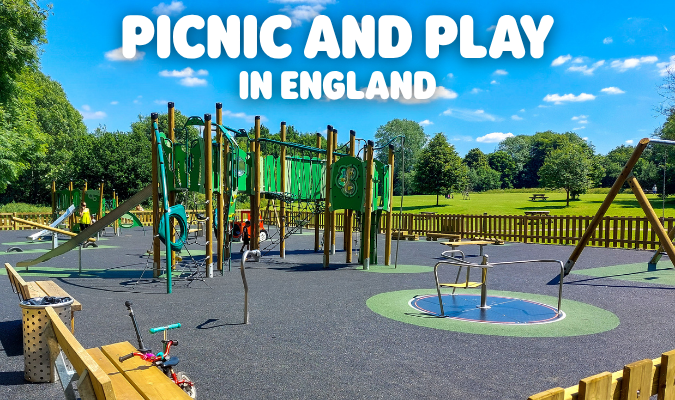
Picnic & Play… in England Welcome to our 2026 Picnic and Play guide, bringing together some of our favourite family-friendly parks and playgrounds across England. With fantastic playground equipment and plenty of space to unpack a picnic, each destination makes the perfect place for a family day out this summer. There are, of course, many […]
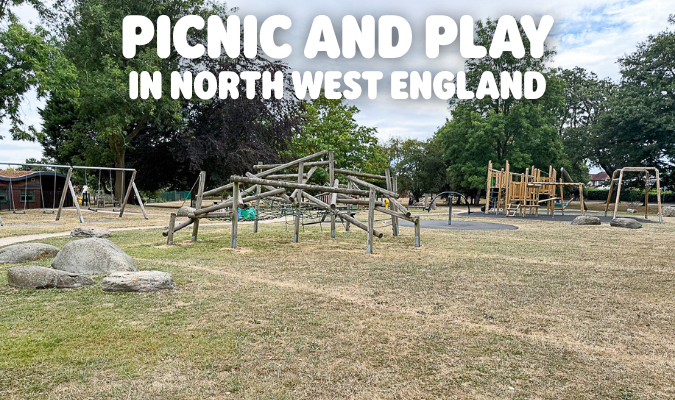
Picnic & Play… in North West England Welcome to Playdale’s Picnic and Play guide for 2026, created to help families find the best parks and playgrounds over the summer holidays! We’ve made sure all these parks are equipped with a fantastic selection of playground equipment and spaces to relax and enjoy a picnic. This time, […]